Masala Dosa – The Fermented Art
Dev
5/1/2026
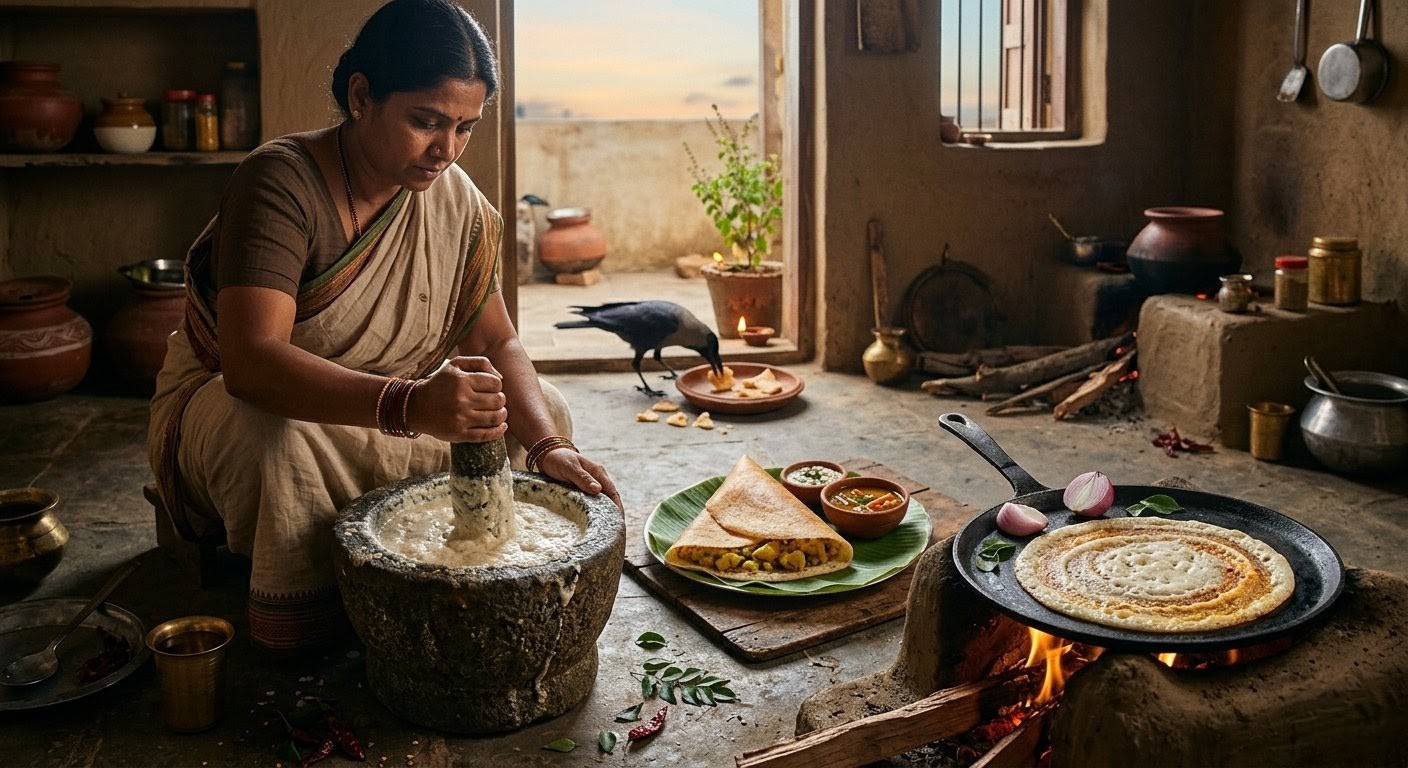
You don’t just cook a masala dosa; you coax life into it. In the warm, moist air of coastal Andhra, before the sun has even touched the tamarind leaves, a stone rolu (grinder) hums its ancient song. A batter of rice and urad dal, fermented overnight, waits like a living being, ready to become a crisp, golden crepe that has travelled from temple sanctums to the irons of street carts. I, your traditional Telugu vantala maestri, today open the doors of my kitchen and my memory so you may master this fermented art in your own home.
The Soul of Fermentation
Fermentation is the unseen deity of Andhra cooking. No yeast, no chemicals — just time, warmth, and the wild yeasts that drift through a coastal kitchen. In our homes, the batter’s rise is never rushed; it is left near the hearth or in the padi (backyard) where the air is thick with moisture. A perfectly fermented batter smells sweet-sour, like rice fields after the first rain. Its surface is bubbled, living. This fermentation breaks down the complex carbohydrates in rice and the protein in dal, making the dosa light, digestible, and packed with gut-friendly microflora.
My secret: I always add a handful of cooked rice to the soaking grains before grinding. This jump-starts fermentation, adds a natural sweetness, and ensures the dosa will never feel rubbery. The stone grinder — not a mixer — rubs the grains apart gently, embedding them with the very air they need to breathe.
A Dash of History
The dosa’s journey began over two thousand years ago, in the Vaishnava temple kitchens of South India. Ancient Tamil literature speaks of dosai as an offering to the divine, made of fermented batter and cooked on hot stone. By the 12th century, the recipe had migrated, and in the rich chilli-growing soils of the Krishna and Godavari deltas, Andhra cooks gave it their own fiery twist.
In Telugu land, the masala dosa became a fusion of that ancient fermented dosa and the spiced potato filling (palya) introduced much later. It is said that the Maratha armies who camped in coastal Andhra carried aloo bhaaji, and our grandmothers, seeing the potato’s mildness, placed it inside a crispy dose, tamed it with turmeric and curry leaves, and created the masala dosa we know today. Every bite holds the memory of those ancient flames and foreign winds.
Hidden Stories from the Village Hearth
No recipe passes in our families without a story. Here is one my ammamma (grandmother) told me:
Before the first dosa was ever served to a mortal, the batter was offered to a crow at dawn. The crow, our ancestor’s messenger, would test the fermentation. If the crow ate greedily, the batter was blessed; if it turned away, the batter needed more time under the stars. Today, in some Krishna district villages, the practice continues silently: the first dosa is never plated; it is torn and scattered in the backyard for the birds.
Another little-known tale: the signature conical folding of the Andhra masala dosa is not just for presentation. In the days when men worked the fields and women packed lunches, the dosa was folded into a triangle (or cone) to keep the potato palya warm inside and to allow it to be held in a hand like a parcel. It was the original farmer’s wrap — nutritious, portable, and deeply satisfying.
The Sacred Ingredients
For the golden, crisp exterior and the soft, flavourful heart, we need:
For the Dosa Batter:
- 3 cups ponni or sona masoori raw rice (or parboiled rice for a softer texture)
- 1 cup whole white urad dal (husked black gram)
- 1 teaspoon fenugreek seeds
- A small fistful of cooked rice (my family’s secret)
- Salt to taste
- Water for soaking and grinding
- For the Potato Masala (Palya):
- 3-4 medium potatoes, boiled and mashed roughly by hand
- 1 large onion, sliced thin
- 2-3 green chillies, slit lengthwise
- 1-inch piece of ginger, finely chopped
- 6-7 fresh curry leaves
- 1 teaspoon mustard seeds
- 1 teaspoon split urad dal
- A generous pinch of asafoetida (hing)
- ½ teaspoon turmeric powder
- 2 tablespoons sesame oil (or groundnut oil)
- Salt to taste
- Fresh coriander leaves for garnish
To Cook and Serve:
Sesame oil or ghee for the dosa
A cut onion half for seasoning the tawa
Coconut chutney, ginger chutney, and sambar
The Chef’s Craft: Step-by-Step Mastery
1. Soaking and Grinding
Wash the rice and dal separately. Soak the rice with fenugreek seeds for 5-6 hours; soak urad dal for 2-3 hours. The dal swells soft and shiny. Drain, but do not discard the soak water — it carries the soul.
In a heavy stone grinder, first grind the urad dal with minimal water until it becomes a smooth, fluffy cloud that floats when you drop a pinch in water. Remove and set aside. Then grind the rice with the cooked rice, adding water gradually, until you get a slightly coarse, grainy batter — like fine sand through your fingers. Mix both batters together in a deep vessel, add salt, and stir vigorously with your hand. The warmth of your hand invigorates the wild yeasts. Cover with a muslin cloth and let it rest overnight in a warm corner.
2. The Morning Test
At dawn, uncover. The aroma should be mildly sour, the batter risen. If it has not risen, place the vessel in a bowl of warm water for an hour. Never add baking soda — it is an insult to our ancestors. A well-fermented batter needs no crutch.
3. The Potato Palya
Heat sesame oil in a heavy kadai. Splutter mustard seeds, then urad dal until golden. Add asafoetida, green chillies, ginger, curry leaves, and sliced onions. Cook the onions until translucent, not brown — we want sweetness to balance the tangy dose. Sprinkle turmeric, and add the roughly mashed potatoes and salt. Mix well, splash a little water, cover and cook for 5 minutes so the potatoes absorb the tempering. Finish with fresh coriander. Keep it moist but not runny.
4. The Sacred Tawa
A well-seasoned cast-iron tawa is the true artist’s canvas. Heat it until water droplets dance and disappear. Dip the cut onion half in oil, and rub the tawa thoroughly — this cleans, seasons, and imparts a subtle allium sweetness. Pour a ladleful of batter onto the centre, and with the back of the ladle, spiral outwards in concentric circles. Do not go back and forth; the spiral creates thin, even grooves that become crisp ridges.
Drizzle sesame oil or ghee around the edges. The oil must sizzle and seep into the tiny perforations. Wait until the underside is golden and releases easily. Do not flip — a true Andhra masala dosa is cooked only on one side, the other steamed from the rising heat.
5. Filling and Folding
Place a generous portion of warm potato palya in the centre, slightly off to one side. Fold one side over the filling, then the other, creating a cylinder or cone. The dosa should crackle as you fold. Serve immediately on a banana leaf plate, with a slosh of white coconut chutney and a bowl of tangy tiffin sambar.
My final secret: Just before serving, I crush a small piece of jaggery into the coconut chutney — the touch of sweet against the fermented tang and chilli heat is divine, and you will taste the soil of Guntur in every bite.
Health Wisdom, Old and New
The dosa is a prebiotic and probiotic powerhouse. The lactic acid bacteria formed during fermentation enhance gut health, improve digestion, and increase the bioavailability of B vitamins. Rice and urad dal together form a complete protein with all essential amino acids — a blessing for vegetarians. The potato filling adds potassium and energy-giving carbohydrates. My grandmother always said, “A masala dosa in the morning keeps the stomach cool all day.” Indeed, the absence of onion in the batter (a mistake modern eateries make) ensures it is sattvic and easy on the mind.
The addition of fenugreek seeds in the batter helps control blood sugar spikes, making it a wiser choice for diabetics when eaten in moderation. Sesame oil, rich in antioxidants and healthy fats, feeds the joints and skin.
Nutritional Essence (per medium dosa with potato filling)
- Calories: ~175 kcal
- Carbohydrates: 28 g
- Protein: 5 g
- Fat: 6 g
- Dietary Fiber: 3 g
- Iron: 1.2 mg
- Calcium: 40 mg
(Values vary with fermentation length and oil used.)
Fascinating Tidbits
The word dose is originally from Kannada dōse, while dosha in Telugu refers to the dosa’s crisp surface. The English “dosa” is a colonial Anglicization.
The world’s largest dosa was made in 2008 in Tamil Nadu, measuring over 30 feet, but the Andhra masala dosa remains unmatched in flavour — so says every Telugu person.
There is a dosa with 100+ varieties in Bengaluru, but in Andhra, we believe the masala dosa is the mother, and all else are her children.
In traditional Telugu feasts (sadya), a small sweet dosa called pesarattu is served as the first course, while the masala dosa is a breakfast star — never mixed.
The Serving Ritual
In our home, the masala dosa is served with three mandatory accompaniments: kobbari pachadi (white coconut chutney), allam pachadi (ginger-tamarind chutney), and a small bowl of tiffin sambar that is thinner and sweeter than meal sambar. The dosa is never cut with a knife; it is torn by hand, gathering chutney and potato together. The first piece is always offered to the divine presence in the kitchen — a tulsi leaf may rest beside the plate.
Parting whisper from the chef:
When you make this dosa at home, do not hurry. Let the batter breathe, let the tawa speak, and let your hands remember. You are not just cooking a dish; you are reviving a lineage. Eat it with your fingers, hear the crunch, and for that one moment, you and Andhra shall become one.
Written by Dev
An insightful contributor exploring the intersections of culture, technology, and everyday life.